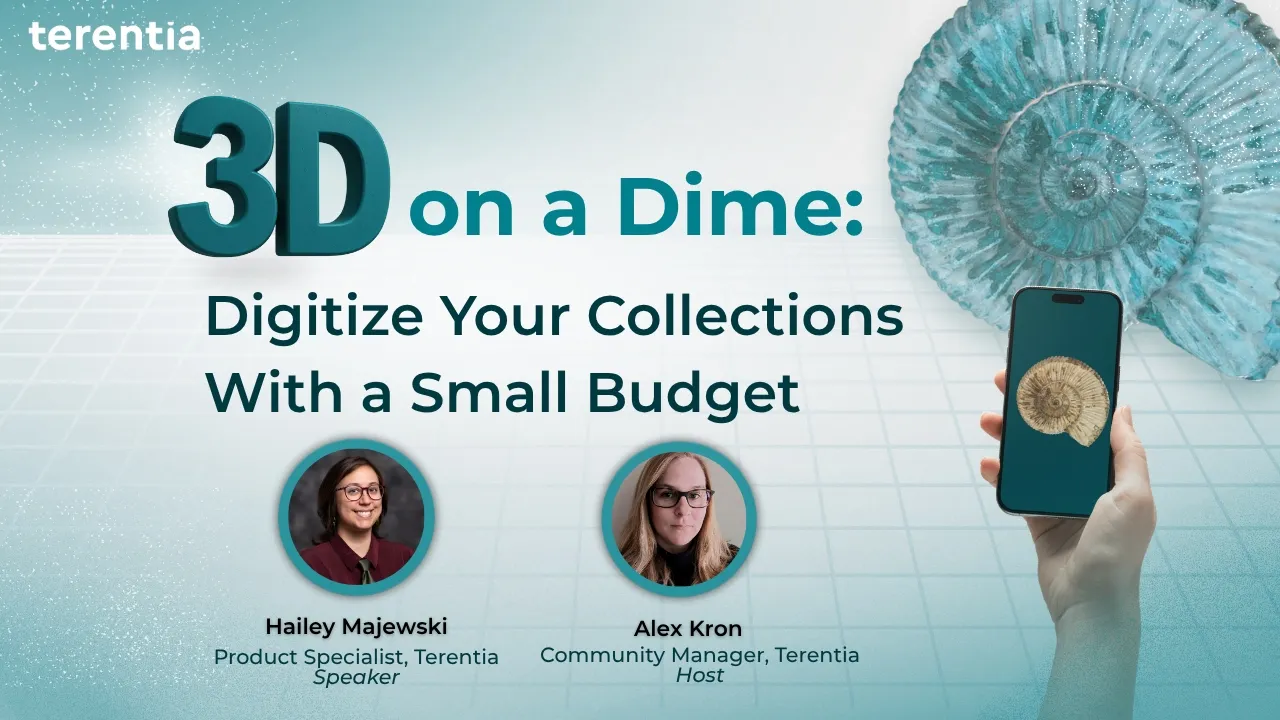
3D on a Dime: Digitize Your Collections With a Small Budget
Couldn't attend Terentia’s webinar on affordable 3D digitization led by our own Hailey Majewski, Product Specialist? Watch the recording now.
About the webinar
3D digitization is no longer out of reach in 3D on a Dime: Digitize Your Collections With a Small Budget. By grabbing just a smartphone, GLAMP professionals can start generating high-quality, three-dimensional replicas—without strain to their budget or resources
Join Terentia’s Hailey Majewski, Product Specialist, for a deep dive into affordable 3D digitization. Explore simple, low-cost methods to create detailed models, covering the basics of photogrammetry, lighting hacks, and file management tips.
Throughout her career, Hailey has digitized everything from tiny insects to a 30-foot dinosaur sculpture—and she’s sharing what actually works. Beyond the how-tos, this session will explore:
The role of 3D assets in DAM strategy
Popular and emerging methodologies for 3D scanning
Metadata, storage, versioning, and long-term access
Best practices for sensitive collections
Engaging your audiences with 3D experiences
If your team is looking for budget-friendly strategies to preserve, share, and celebrate its collections in 2026 and beyond, this session is for you.
Meet our speakers

Hailey Majewski
Product Specialist
Terentia
Hailey Majewski is a dedicated industry professional with over 10 years of expertise in natural history collections, with a focus on digitization, data standards, and database management.
During her tenure at the Cleveland Museum of Natural History, she launched a 3D digitization program and championed the institution-wide adoption of a new DAM.
Now serving as a Product Specialist at Terentia, she designs client systems that cater to GLAMP institutions and their unique data needs.
Alex Kron
Community Manager
Terentia
With over 15 years of experience in information and project management, Alex Kron specializes in researching, selecting, and implementing cultural technology solutions, collection management, digital asset management, and digital preservation.
She has worked across commercial, nonprofit, academic, and arts and culture sectors for and alongside museums. Previous roles include Curator of Collections at the San Diego Model Railroad Museum and Digital Operations and Collections Information Analyst at Balboa Park Online Collaborative
Alex also teaches as a Digital Preservation Lecturer for Johns Hopkins University’s Museum Studies and Digital Curation Programs.
FAQs
What is 3D digitization?
3D digitization is the process of creating a three-dimensional replica of a physical object.
This practice is done by capturing an object from multiple angles, either through photogrammetry or 3D scanning technologies, and processing the data to generate a 360-degree model that's viewable, interactive, and useable across digital channels.
Why does 3D digitization matter?
3D digitization matters because all objects degrade over time. Creating 3D replicas, otherwise known as "digital twins," keeps the physical objects safely stored while their digital counterparts can be handled and inspected without fear of damage.
For GLAMP institutions, 3D digitization makes it possible to preserve objects in greater detail, expand access through online collections, and support research, education, and conservation efforts—all without needing the physical object in hand.
Do I need specialized equipment to get started with 3D digitization?
Not at all! You don't need specialized equipment to create usable 3D models at your institution.
As discussed in the session, many teams get started with just a smartphone and photogrammetry apps, paired with their digital asset management system (DAMS). While higher-end scanners can improve precision, they're not a must-have when building 3D workflows.
What is photogrammetry, and why is it a good low-cost option?
Photogrammetry is the process of creating 3D models from a series of 2D images taken from multiple angles.
It’s one of the most accessible and budget-friendly methods because it can use tools you likely already have—like a smartphone or even DSLR cameras—paired with software to process the images.
Is a digital asset management system required for managing 3D assets?
Yes, a digital asset management system (DAMS) is recommended for managing 3D assets.
Since 3D assets can be large and complex, it’s beneficial to manage them in a platform that supports their versioning, metadata, and scalable storage. A modern DAMS, like Terentia offers, can help ensure your files remain accessible, searchable, and preserved for the long term.
How can 3D assets fit into my DAM strategy?
3D assets should be treated like any other high-value digital asset. That means integrating them into your DAM workflows for ingestion, metadata management, permissions, and distribution, so they’re not siloed or difficult to reuse.
3D models can be collections surrogates in GLAMP, forging new avenues for research, interpretation, and audience engagement:
Digital twins: Exist as a detailed replicas of physical objects, creating new avenues for sharing, interactivity, and preservation.
Storytelling potential: Can be used across web viewers, mobile apps, VR/AR experiences, virtual tours, and on-site interactives.
Remote access: Support online research, teaching, and virtual exhibitions when in-person access isn’t possible.
Where can I learn more about Junaluska Museum's 3D projects that Hailey references in the webinar?
Take a closer look at the museum's digital transformation in our recent webinar, ᏚᏘᏱ (Snowbird) Histories: Advancing the Digital Future of the Junaluska Museum, and its accompanying case study.
Without a physical space to display their collections, the small, dedicated team at Junaluska Museum leveraged Terentia to build a fully virtual museum.
Early in the project, Hailey encouraged staff to try 3D digitization during an on-site visit, sharing how to create 3D replicas using just a smartphone. Their team ran with the idea, eventually expanding to DSLR cameras as their skills grew.
You can see the results in the online exhibit, Rooted in Resistance: The Legacy of Junaluska and the Snowbird People.
How do I get invited to Terentia webinars, and when is the next one?
To never miss a webinar, sign up for our newsletter and have event invitations, thought leadership, and great content for GLAMP institutions delivered to your inbox. We only send a handful of emails per month, and it's an easy way to stay in the loop.
Our next webinar is Navigating the DAMS Buyer's Journey with Nasher Sculpture Center on April 15, 2026. Register now for an in-depth look into
Make 3D digitization part of your DAM strategy with Terentia
So, you watched 3D on a Dime: Digitize Your Collections With a Small Budget—and now you have questions?
Reach out with your 3D digitization queries for Hailey. Or request a personalized demo of Terentia to see how the platform could elevate your DAM and digital initiatives.
Browse our resources
Never miss another webinar
Enjoying our sessions? Sign up for Terentia's mailing list to stay updated on upcoming webinars and events.
