Digital Storytelling for Museums and Archives: Storyline
When The King Center approached us about "When Faith Calls", we saw an opportunity to do more than put a series of films online. That idea became Storyline.

Founder & CEO
When we started Terentia, we strongly believed collections are about much more than managing records. Museums, archives, libraries, and cultural organizations hold extraordinary stories, but making a collection available online does not necessarily mean people will discover those stories.
Search is an important part of that experience, and it always will be. But people do not always begin with a search box. Sometimes they begin with a film, an oral history, an exhibition, a photograph, or a person whose story catches their attention. We have long been thinking about how Terentia can help institutions meet audiences at that point of curiosity and lead them deeper into their collections.
That thinking took a significant step forward when one of our long-term community members approached us about a new six-part documentary series, When Faith Calls, by The Martin Luther King, Jr. Center for Nonviolent Social Change (The King Center).
The straightforward approach would have been to create a beautiful webpage where audiences could watch the films. That would have been fine, but it felt like we would be missing an opportunity. The King Center has an extraordinary archive, and so much of the history behind the films already exists in its photographs, documents, records, objects, and information about the people and places represented in the series.
In collaboration, we started asking what it would look like if those two things did not have to live separately.
That is where Storyline began.
Connecting the moment on screen to the collection behind it
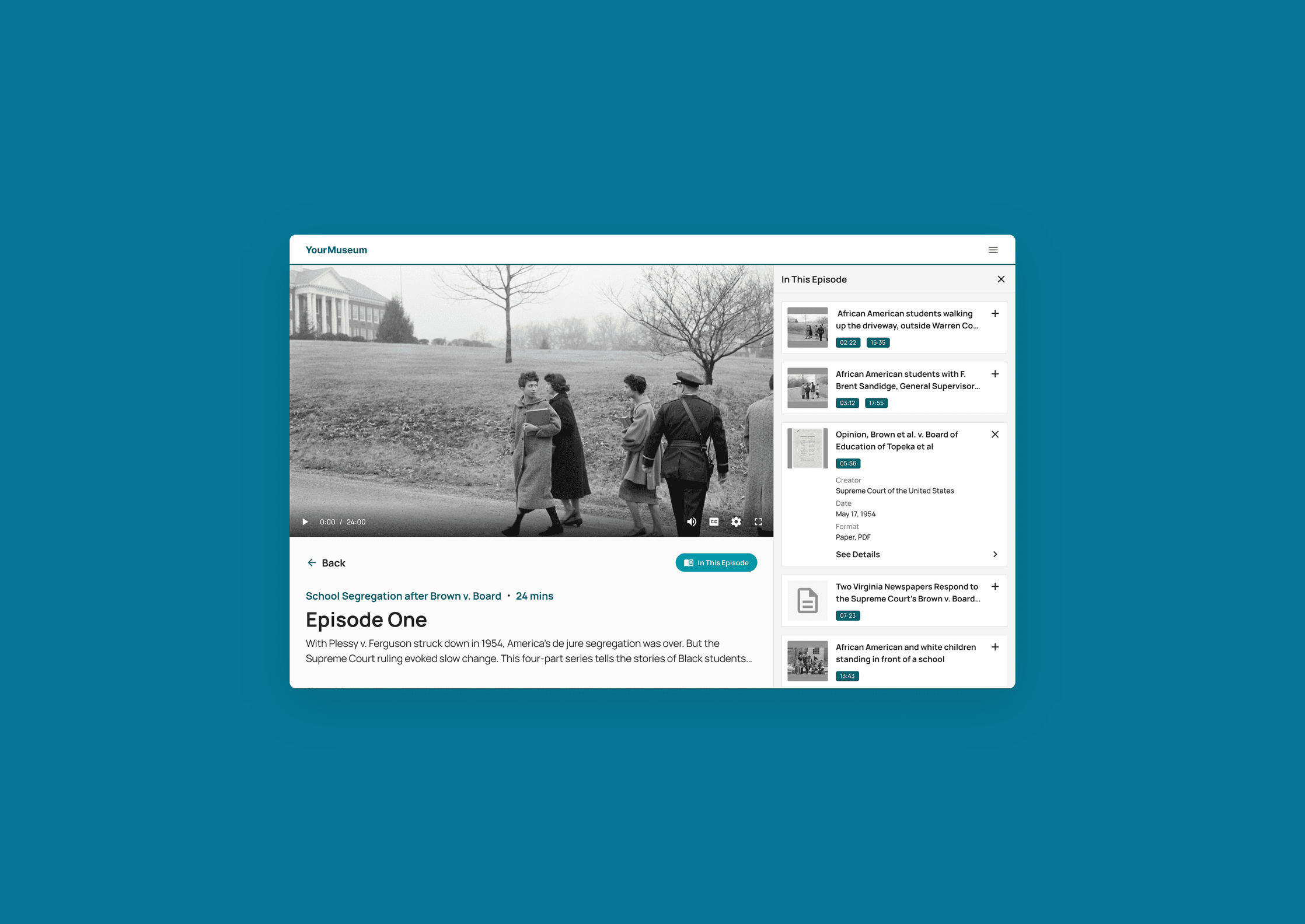
The basic idea behind Storyline is fairly simple. An institution can add time-coded annotations to specific moments in a video and connect those moments directly to materials in its collection.
If someone is mentioned in an interview, the annotation might connect to that person’s record. If an object appears on screen, a viewer can explore it and learn more about its history. A reference to a particular event might connect to a photograph, document, place, or archival record that provides more context.
Those connections appear at the point in the video where they are relevant. The viewer can choose to explore them, learn more, and then continue watching.
For us, that timing is important. We didn't want Storyline to turn a film into a complicated interactive experience that constantly demands the viewer’s attention. The film still needs to work as a film. Storyline simply gives someone another path when something they see or hear makes them want to know more.
That distinction became especially clear while working with The King Center. A documentary necessarily has to make choices about what it includes. An entire collection of records connected to a moment may receive only a few minutes on screen. Storyline gives the institution a way to make some of that deeper context available without trying to fit everything into the film itself.
Seeing the idea come to life with When Faith Calls
When Faith Calls is a six-part documentary series exploring how faith shaped the life, leadership, and legacy of Dr. Martin Luther King Jr. The series moves through important periods and events in his life, including Montgomery, Birmingham, the March on Washington, and Selma.
As viewers watch the series, Storyline lets The King Center connect moments in the films with photographs, documents, archival records, and other historical materials from its collections. Instead of asking someone to remember a name or event and search for it later, the relevant source material can be available as that part of the story unfolds.
Dr. Kelisha B. Graves, Chief Research, Education, and Programs Officer at The King Center, described the experience this way:
“Working with Terentia on Storyline has allowed us to think creatively about how audiences can engage with When Faith Calls beyond the traditional documentary experience. Their team has helped us translate our vision into an interactive experience that connects the film with meaningful digital artifacts, giving audiences opportunities to explore the stories more deeply. The collaboration has helped us bring together storytelling, technology, and our digital collections in a way that makes the experience more accessible, engaging, and dynamic.”
I think that is an important way of describing what we were trying to accomplish. Storyline is not really about adding more content to a video. It is about creating a connection between a story and the knowledge an institution already holds.
Keeping the collection at the center
Another principle mattered to us as we developed Storyline. We did not want institutions to have to create and maintain another disconnected repository just to build this kind of experience.
Storyline is an interactive video storytelling module available with Collections Online within Terentia’s Collections Engagement offering. The photographs, documents, people, objects, and places connected to the video are part of the same collection ecosystem the institution already manages in Terentia.
The time-coded annotation creates the relationship between a moment in the video and that underlying collection information. If the record changes, new material is digitized, or the institution’s interpretation develops over time, the collection remains the foundation of the experience.
That is consistent with how we think about the broader Terentia platform. We do not want an institution to have to copy its collections into a different system every time it wants to create something new for an audience. We would rather make it easier to build new experiences from the collection itself.
The people who understand those collections also remain central to the process. An archivist or curator may recognize that a photograph adds an important detail to a particular moment, or that a person record opens up a much larger part of the collection. Storyline gives them a way to put that knowledge directly into the viewing experience.
As Adrian Cooper, our Chief Product Officer, puts it:
“The technology is only part of this. The real value comes from the knowledge of the archivists, curators, and educators who understand the collection. Storyline gives them a way to decide which moments deserve more context and what material will help the audience understand them.”
You can see more about how this works on our Digital Storytelling page.
Where we think Storyline can go next
When Faith Calls is the first public Storyline experience, but documentary film is only one of the ways we imagine institutions using it.
Oral histories are an obvious example. Someone may spend an hour talking about people, neighborhoods, events, or objects that exist elsewhere in the collection. Timecoded annotations can connect those references directly to the relevant material without changing the oral history itself.
The same idea applies to archival footage. A viewer could learn who the people on screen are, explore a building or place, or see records related to the event being filmed. Educational videos could connect students directly to primary sources, while recorded performances could link to costumes, programs, designs, photographs, and production records.
What interests me is that none of those examples requires an institution to start from scratch. Many organizations already have the video. They already have the collections. They already have the expertise within their teams. Storyline is about creating meaningful connections between those things.
Sometimes that journey will begin with search. Sometimes it will begin with an exhibition or an educator. And sometimes it will begin because someone is watching a film and suddenly wants to know more about the person they just saw, the object being discussed, or the event that shaped the story.
That is the moment Storyline is built for.
Seeing it come to life with The King Center is particularly meaningful because of our long relationship and the trust they placed in us to help think beyond simply putting When Faith Calls online. It also continues something we have been working toward at Terentia from the beginning: helping institutions not only manage and preserve their collections, but use those collections to tell richer stories and create deeper connections with their audiences.
I am excited to see where institutions take it next.
Explore Storyline
Book a "Show and Tell" to learn how Storyline connects video, oral histories, archival footage, and other time-based media with the collections behind them.
Browse our resources


Enjoyed the read?
Stay in the loop with Terentia. Join our mailing list for GLAM professionals to get new blogs, case studies, guides, and more great content delivered to your inbox.
