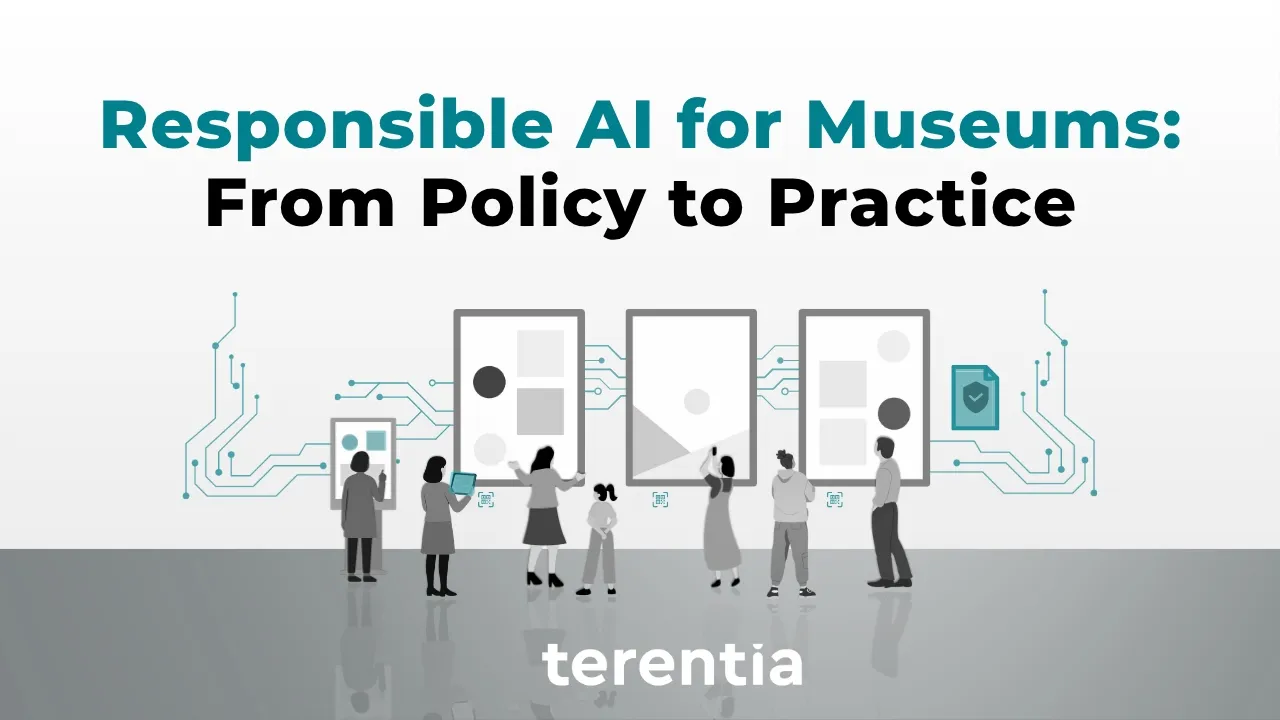
Responsible AI for Museums: From Policy to Practice
See what 290 professionals in GLAMP—galleries, libraries, archives, museums, and performing arts—shared about AI, policy gaps, and what needs to happen next.
With or without a museum AI policy in place, artificial intelligence is quietly showing up in GLAMP institutions. It’s arriving in tools used daily, like email inboxes, search engines, and productivity software.
Every time a new AI feature appears, the risk to institutional data grows. Addressing that reality takes two things: a formal policy that gives staff clear guidance on responsible AI use, and the follow-through to make sure it's actually applied.
To guide museums, Terentia hosted Responsible AI for Museums: From Policy to Practice, the latest webinar in our Navigating AI for Museums series. Nik Honeysett, Director & CEO of Balboa Park Online Collaborative, and Neal Bilow, Founder & CEO of Terentia, were joined by 290 attendees from across the sector.
Watch the recording for the full insights, and scroll down for key takeaways and data surfaced from the session.
Key takeaways
Adoption is outpacing governance: Staff are already using AI with or without institutional approval. Shadow AI is widespread, and policy needs to catch up.
A formal policy isn't the only starting point: Even a brief staff communication that says be transparent, maintain institutional values, and disclose AI use is better than silence.
Provenance is the framework cultural institutions already understand: Tracking what AI tools were used, what prompts were applied, and who reviewed the output isn't a new concept for the sector, it maps directly onto existing practice.
Disclosure is becoming a legal obligation, not just an ethical one: The EU AI Act and California AI Transparency Act both point toward requirements that will affect how institutions publish AI-assisted content globally.
AI-assisted and AI-generated are not the same thing: How AI is used in a workflow is a different question from whether AI produced the final artifact. Policy needs to account for both.
Cultural institutions are positioned to become centres of truth: Public AI models scrape and remix the internet. Museums verify, contextualize, and curate, which is a meaningful distinction as trust erodes in AI-generated content.
Your vendor relationships matter: Institutions should be asking where their data is stored, whether it’s being used to train AI models, and what their vendor’s AI roadmap looks like.
Policy needs to be a living document: The landscape is changing too fast for a set-and-forget approach. A governance committee that can respond to new tools, regulations, and use cases is more valuable than a perfect policy document.
AI in museums: What the data is showing
How museums feel about artificial intelligence is shifting. Data collected by Terentia points to increased exploration, recognition of AI’s varied uses across institutions, and a strong commitment to a human-in-the-loop approach.
Note: Poll responses were voluntary and their results should be read as directional, rather than statistically representative of the museum sector as a whole.
Many museums are exploring AI, not avoiding it
During registration, interested attendees were invited to share their institution’s relationship with AI. Out of the 468 responses:
43% are exploring AI use at their institutions
32% are experimenting and piloting AI tools
15% haven’t started engaging with AI yet
10% actively use AI in their workflows
Takeaway: Curiosity about AI is high, even among institutions that haven’t yet taken a formal step towards implementation.
Most institutions still need an AI policy
Despite growing AI adoption in museums, formal governance hasn’t kept pace. Out of the 203 poll responses from webinar attendees:
24% plan to create an AI policy but haven’t started
21% have an informal or draft policy that isn’t implemented
21% have no current plans for a policy
19% aren’t sure if their institution has an AI policy
15% have a formal AI policy that’s actively used
Takeaway: Cultural institutions recognize the need for a museum AI policy, but many haven’t yet built and implemented theirs.
Museums are using AI in a variety of ways
When asked how their institutions are currently using AI, attendees could select multiple use cases, reflecting how varied adoption already is across the GLAM sector. Out of the 178 responses:
Administrative tasks and staff productivity: 74 responses
OCR and transcription: 61 responses
Marketing and communications: 55 responses
Image and media recognition: 36 responses
Exhibition content development: 31 responses
Fundraising and grant writing: 23 responses
Cataloguing and metadata enrichment: 22 responses
Collections research and discovery: 22 responses
Digital preservation and archival workflows: 13 responses
64 respondents said they haven’t implemented AI yet, offering a meaningful baseline for where the sector as a whole currently sits.
It’s still early days for AI use in collections and DAM
AI is making inroads across museum operations, but collections and digital asset management remain largely in the exploratory stage. Out of 164 responses:
35% are piloting or experimenting with AI
29% aren’t using AI at all
18% only use AI for non-collections tasks
14% aren’t sure
4% actively use AI with collections data and/or digital assets
Takeaway: Only a small fraction of institutions have moved beyond AI experimentation, suggesting time is needed for the sector to establish the confidence and governance frameworks to go further.
Staff are committed to reviewing AI output
Museums are trusted stewards of knowledge, and that instinct carries over into how staff approach AI.
When asked how often a human reviews AI output before it’s used externally or stored in a system of record, out of 179 responses, excluding the 49 who don’t use AI:
63% said always
24% said often
9% said sometimes
4% said rarely or never
Takeaway: Staff oversight remains a professional priority, even where formal AI policy hasn't yet caught up.
Move from policy to practice with responsible AI
The data is clear: most museums know they need to act on AI, but haven’t yet. Terentia helps GLAMP institutions engage with AI in a secure environment, with full control over how their data is being accessed and used.
Powered by Microsoft Azure, Terentia’s opt-in AI features reduce the manual burden of collections and DAM workflows:
Automated image tagging: Identifies objects, people, text, and colour, generating keywords with confidence scores for easy review.
OCR transcription: Makes documents, PDFs, and handwritten records fully searchable.
Video indexing: Generates transcripts, segments scenes, and tags content with multilingual support.
AI-powered search: Understands context, not just keywords, to surface more relevant results across your collections.
Request a consultation to see how your institution can use AI safely and responsibly.
FAQs
What is a museum AI policy?
A museum AI policy is a formal document that defines how an institution permits, governs, and oversees the use of artificial intelligence tools by its staff. It typically covers acceptable use, data privacy and security, intellectual property and copyright, transparency and disclosure requirements, and parameters for human review.
What should a museum AI policy include?
A practical AI policy for museums typically addresses three tiers: legal and security compliance, institutional integrity and transparency, and mission-aligned values. It should also include implementation guidance and a simple decision framework staff can actually use.
What is a trusted AI digital repository?
A trusted AI digital repository is a closed knowledge network built from an institution’s own verified data. The institution controls what content is included, how it’s used, and what AI experiences are built on top of it. Unlike public LLMs trained on data scraped from the internet, this model draws on curated data to support more accurate and trustworthy AI outputs.
How does Terentia support responsible AI use?
Terentia upholds core commitments of responsible AI: your data stays private, you remain in control of it, and it’s never used to train AI models. The platform supports provenance metadata tracking, granular permissioning over which assets can be used by AI, and the infrastructure needed to build AI experiences from your own data.
Terentia’s AI features are also opt-in, so clients have the ability to choose to use AI or not.
Does Terentia have an AI policy?
Yes, Terentia maintains an updated AI use policy to show how client data stays private, protected, and under their sovereignty while using our platform..
Browse our resources

Never miss another webinar
Enjoying our sessions? Sign up for Terentia's mailing list to stay updated on upcoming webinars and events.
