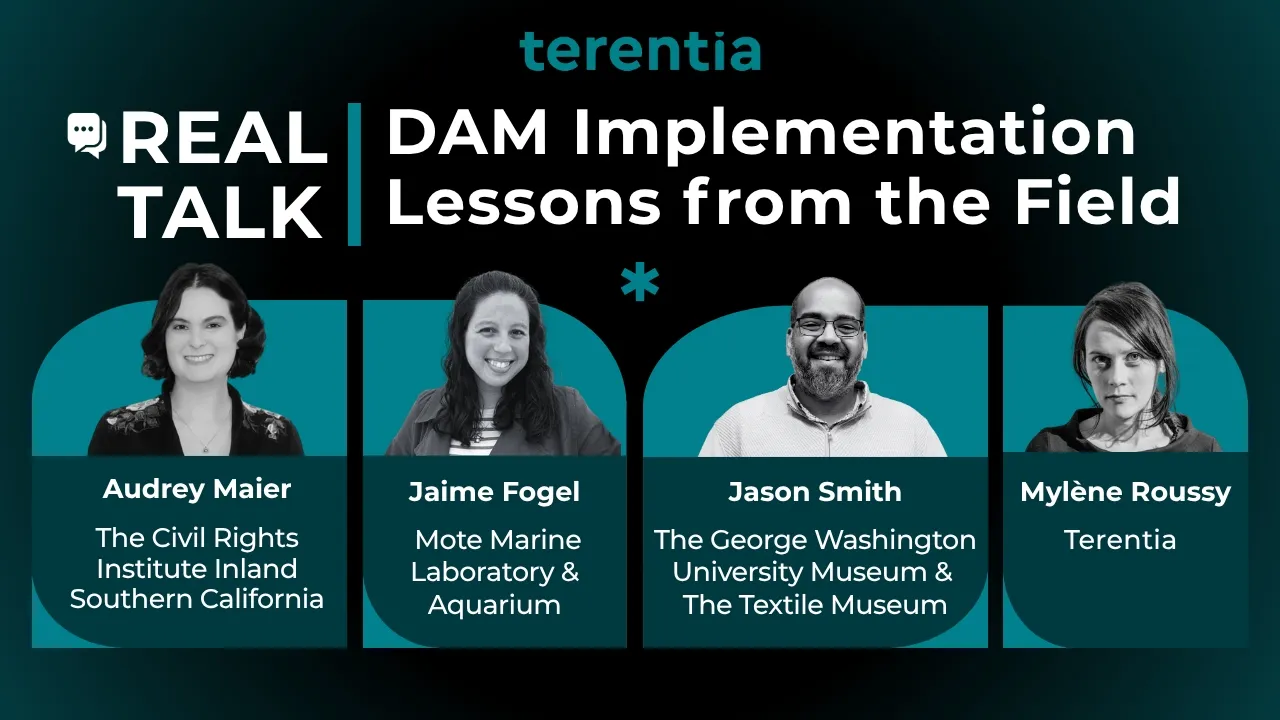
Real Talk: DAM Implementation Lessons from the Field
See what 260+ GLAMP professionals told us about what’s hindering their DAM implementation. Plus, hear candid insights from three institutions who lived through it, in their own words.
What happens after choosing a new digital asset management (DAM) system is where many cultural institutions get stuck. The DAM buyer’s journey has its own set of considerations, but the DAM implementation itself tends to arrive with even more.
Even with the best intentions, blockers start to appear. Inconsistent metadata that won’t migrate smoothly. Staff struggling adapt to the new platform. Or the DAM itself, feature-rich but never built with collections data—or the teams stewarding it—in mind.
Real Talk: DAM Implementation Lessons from the Field addresses these challenges head-on. Hosted by Terentia’s Alex Kron, Community Manager, the webinar brought together three practitioners who’ve led DAM adoption at very different institutions:
Jaime Fogel, Library & Archives Director, Mote Marine Laboratory & Aquarium
Audrey Maier, Public History Director, The Civil Rights Institute of Inland Southern California
Jason Smith, DAM Administrator, The George Washington University Museum and The Textile Museum
They were joined by Terentia’s Mylène Roussy, Lead Implementation and Project Manager, for the vendor’s-eye view, along with attendees from across the GLAMP sector (galleries, libraries, archives, museums, performing arts).
What followed was a candid, data-backed look at taking a new DAM from out-of-the box to up-and-running, with the best possible ROI.
Key takeaways
DAM implementation doesn't follow the standard tech-rollout playbook. GLAMPs have unique data, staffing, and stewardship needs, often making it challenging for general-purpose DAM vendors to support them, especially without sector experience.
Inconsistent metadata is a much-reported headache. This challenge was much-cited by the Real Talk speakers, and topped an attendee poll on what makes digital assets hard to manage.
Staff buy-in can’t end at go-live. Nurturing it is an ongoing practice. The panelists’ most effective tactics were phased training, self-serve resources, dedicated area admins, and (no joke!) snacks and swag.
A DAM delivers the most value when connected to a larger tech stack. Every panelist pointed to integrations with a collections management system (CMS), online collections, or website as a deciding factor in their DAM selection.
Slower, phased rollouts are normal, and not necessarily a sign of failure. Day-to-day work in GLAMPs doesn’t slow down for a DAM implementation, and building room for that reality is part of doing it well.
Where GLAMPs stand on DAM implementation
Attendees shared where they are in their DAM journey and the challenges being faced through pre- and mid-session polls. Their responses paint a picture of a sector eager to modernize, but still navigating familiar roadblocks around staffing, metadata, and adoption.
Note: Poll responses were voluntary and should be read as directional, rather than statistically representative of the sector as a whole.
Most attendees were early in their DAM journey
In the registration poll, an overwhelming majority of attendees indicated their institutions are still a ways off from implementation. Out of the 262 responses received:
51% are just beginning to explore their options
14% are actively evaluating or selecting a DAM
11% are already using a DAM and aren’t looking to change
11% are currently in implementation or migration
7% have selected a DAM and are preparing for implementation
5% have launched and are working on adoption
Takeaway: If your institution is starting its DAM journey, you’re in good company. Most webinar attendees were too, and likely asked the same questions on your mind.
Internal resources are the top implementation challenge (by far!)
Many attendees pointed to limited resources as their biggest obstacle—whether actively implementing a DAM, preparing to, or already post-launch. Out of the 229 registrants that weighed in:
46%: Limited internal resources or expertise
25%: Competing priorities pulling focus away
15%: Unclear expectations around who owns what
7%: Getting stakeholder buy-in
7%: Vendor promises not matching reality
Takeaway: Before a single asset gets migrated, most already expect that staff capacity—not budget or technology—will be the hardest part of DAM implementation. The panel's lessons echoed the same.
Staff time and capacity are also the biggest concern
Managing internal resources was a focal point throughout the webinar. When asked what worried them most about implementation, 124 attendees responded:
36%: Limited staff time or internal capacity
19%: Connecting their DAM with a CMS, online collections, or other systems
15%: Cleaning up inconsistent metadata
13%: Sustaining DAM governance after launch
9%: Migrating legacy data without losing context
6%: Getting staff buy-in across departments
2%: Defining permissions and access levels
Takeaway: Implementation worries vary by institution, but finding the time and team bandwidth to see it through was the clear frontrunner.
Digital assets are difficult to manage for many reasons
But the challenges don’t begin at implementation, especially for teams already reckoning with ever-growing digital collections.
Attendees were also asked what’s currently making their digital assets hard to manage (with multiple selections allowed). Their answers help show why so many institutions are investing in a DAM. With 125 attendees voting:
76%: Metadata is incomplete, inconsistent, or unreliable
58%: Assets are scattered across storage locations
44%: Different departments use different workflows or systems
43%: It's difficult for staff to find what they need
41%: Rights and permissions are unclear
28%: Lack a clear system of record
19%: Have a DAM, but adoption is uneven
Takeaway: Clean metadata isn’t optional. 3 out of 4 attendees named its management as an active pain point. That’s the clearest sign of where an implementation needs to focus first.
The DAM itself is often a barrier to staff adoption
Your chosen digital asset management system is often the make-or-break factor in adoption. Pick one that’s tough to learn, or unequipped to support different teams and their workflows? Staff buy-in is likely to suffer.
When polled on the biggest barrier to adopting a new DAM, 110 attendees responded:
28%: DAM system feels too complicated
18%: Leadership support is limited or inconsistent
17%: Lack of time for DAM training
14%: Departments have different needs and expectations
13%: Staff are comfortable with existing workflows
6%: Unclear ownership or accountability
4%: Staff don't trust the data yet
Takeaway: Adoption barriers are less about staff resistance, and more likely about the system’s ease-of-use, leadership buy-in, and allocated training time—all of which can be planned for.
Every successful project starts with the right DAM vendor
Real Talk: DAM Implementation Lessons from the Field made one thing clear: whether a new system’s implementation succeeds or stalls depends on the partnership behind it.
Choosing the right DAM vendor makes all the difference. That means finding one with proven success with cultural institutions, a DAM system built to support digital assets and collections, and a reputation for white-gloved service at every stage.
Terentia has partnered institutions of all sizes in bringing order to digital chaos. Our platform unifies DAM, collections management, online collections, and digital storytelling in a single interface. Each implementation is carefully adapted to the client’s unique needs, rather than a one-size-fits-all rollout.
That attentive approach doesn’t end after go-live. Every client gets free, unlimited post-launch training and support. And because Terentia is built for integration, it can connect seamlessly with your existing CMS and software, instead of asking you to replace what’s already working.
Book a 15-minute call to talk through your DAM needs. Or browse our case studies to see how institutions, like yours, are achieving incredible outcomes with Terentia.
FAQs: DAM Implementation
How to implement a DAM system?
DAM implementation starts with assessing your digital assets, stakeholders, and pain points before selecting a system, then mapping and migrating legacy metadata, rather than copying it over as-is. From there, most institutions roll out in phases, such as department by department, while training staff throughout the process. DAM governance should be established early, alongside a plan for integrating with your existing software.
What are the hidden costs of DAM implementation?
The biggest hidden cost of DAM implementation is staff time. Cleaning and mapping legacy metadata, building controlled vocabularies, and developing staff training materials all require dedicated hours, often best managed by a specific role like a DAM administrator. Ongoing adoption, governance, and integration with existing systems all require continued investment.
How long does DAM implementation take?
There’s no universal timeline for DAM implementation in GLAMP institutions. A small museum might finish a first phase in months, while a larger institution with several departments may treat it as a multi-year, collection-by-collection project.
What makes DAM implementation different for museums, libraries, archives, and non-profits with collections?
These DAM implementations differ from corporate rollouts in several key ways. Staff are often smaller in number and multi-hat, and many institutions steward materials that are unique or irreplaceable, sometimes with no physical backup or IT department. Needing to manage digital assets alongside collections also comes with unique requirements that many enterprise DAM vendors are unequipped to support, resulting in delayed or inadequate implementations.
What should I look for in a DAM vendor for a cultural institution?
Look for a DAM vendor with direct experience in the GLAMP sector, a platform that can scale to your institution’s size and resources, rather than forcing a standard rollout, and support that continues well past go-live. If your institution has an existing software stack, especially if it includes a collections management system (CMS), make sure that your intended DAM can integrate with it prior to purchase.
Browse our resources

Never miss another webinar
Enjoying our sessions? Sign up for Terentia's mailing list to stay updated on upcoming webinars and events.
