Case study
Scaling the Digital Architecture to Double the Archives
Why a major acquisition inspired the Magnes Collection of Jewish Art and Life to modernize its DAM, collections management, and public access
© Magnes Collection of Jewish Art and Life

Organization
Magnes Collection of Jewish Art and Life at the University of California, Berkeley
Headquaters
Berkeley, California
Industry
Museum
collections objects
x
faster searches
+
public records (so far!)
Organization
Magnes Collection of Jewish Art and Life
Part of the University of California, Berkeley, the Magnes Collection of Jewish Art and Life is one of the world’s preeminent Jewish museums. But despite its 60,000 holdings and importance as a research collection, the institution isn’t a large one.
“Making the collection available beyond our physical space is really important,” says Hannah E. Weisman, Executive Director. “Our museum is smaller in size in terms of staff and physical facilities than others with collections of our size.”
The museum runs on a staff of eight, each covering a department of one. “We all wear multiple hats on our team,” says Andrea Calderon, Registrar & Collections Manager. Legacy systems compounded the challenge, leaving the small team with little digital presence to draw in the audience passing right outside its doors.
“I think physically and digitally we’ve been a little isolated,” explains Tina Kremzner-Hsing, Database & Digital Assets Manager. “It’s a bustling area. But people don’t know to come in.”
Faced with these challenges, a new development was about to become the catalyst for a major digital transformation, made possible by the adoption of Terentia’s full platform.
Objectives
Moving forward from a legacy collections management system
Prior to Terentia, how the Magnes Collection of Jewish Art and Life managed its collections and digital assets had long become a source of frustration for its small team.
But after acquiring the Roman Vishniac Archive—which at 30,000+ objects doubled the Magnes’s holdings—and starting its processing work, leadership and the team agreed: it was time to adopt new systems.
A peek into the Magnes storage. Photo courtesy of Magnes Collection of Jewish Art and Life, University of California, Berkeley
A museum software stack keeping a small team stuck
Accessing the Magnes’s legacy collections management system (CMS) was an exercise in patience. It meant first logging into a VPN, opening a remote desktop session, and then connecting to an overseas server.
Once logged in, the connection often failed mid-task, risking lost work and forcing a restart. These frequent crashes made records searches tedious for staff—and nearly impossible for the public.
Not having a digital asset management (DAM) system caused further problems. Images were stored in folders on a campus server, without the ability to apply metadata for easy retrieval, version control or standardized naming conventions.
Unable to integrate this setup with their CMS, the team couldn’t associate digital assets with collections records without manually typing in file paths for each individual image. Let alone publish them en masse to the Flickr page that acted as an online collection.
Making the business case for modernizing
In 2023, when Tina was hired into the Magnes’s new Database & Digital Asset Manager role, she saw she had a challenge ahead of her.
“The first thing I did was go through all of our assets to figure out which ones were duplicates—of which we had many—and then standardize the file names,” she recalls. “But the photos would depict an object with a different accession number from the file name. It took a long time for me and our Collections Manager to go through everything.”
Inspired to make a change, Tina began working to secure leadership’s buy-in for a new system.
“I made the case that everything could be a lot more efficient,” she says, “and we could publish so much more online if we had a digital asset management system.”
“Plus, part of our revenue streams is rights and reproductions. So, we needed a [better] way to publish our images online, making them searchable and usable to license.”
One acquisition, double the archives
The Magnes’s digital infrastructure was already precarious when a generous donation put its instability into a new light.
In 2018, Mara Vishniac Kohn donated her father's life work, the complete archive of renowned photographer Roman Vishniac, to the museum.
Spanning more than 30,000 photographs, negatives, audiovisual materials, correspondence, and memorabilia, the Roman Vishniac Archive would double the size of the collection overnight and eventually triple its number of records.
The team’s existing systems were no match for an acquisition of that scale. “We needed something that could support such a large influx of records and materials,” Tina says. “We needed to do that efficiently.”
The Magnes team needed more than a patch for the aging CMS. They needed a platform built to grow with the museum for years to come.

Photo by Keegan Houser, courtesy of University of California, Berkeley.
Solution
Terentia: The first and final vendor considered
The Magnes’s evaluation of Terentia began two months into Tina’s tenure. Visiting Terentia’s booth at DAM and Museums 2024, the new Database & Digital Asset Manager was inspired by what she saw: a single platform that integrated collections management, digital asset management, and online collections.
She came away convinced the Magnes needed to overhaul its entire system. It was a bold call, and leadership encouraged her to do more research first: request demos, gather quotes, and build a real point of comparison.
So, Tina did. She evaluated other solutions: 10 CMS vendors, 9 DAM vendors, and 6 online exhibition platforms, to be exact. Plus, she checked in with two peer institutions using another CMS system.
None of it changed Tina’s mind. Terentia was, as she puts it: “The first vendor that I spoke to. It was also the last vendor I spoke to for that reason.”
“[Terentia] immediately stood out because of the integration with a digital asset management system that was a true digital asset management system,” Tina says. “After looking at different collection management systems and comparing prices, none of the other CMSs on the market that we were considering had a built-in integration with a DAM system.”
For the team, implementing a truly all-in-one platform was the only manageable option. As Tina explains, “I didn’t want to have to deal with a DAM system that was a separate purchase order, a separate team, a separate process, and then have to figure out a way to integrate it with the CMS. I just knew we wouldn’t be able to handle that amount of work.”
Hannah, who signed off on the investment, pointed to another deciding factor: affordability. “The partnership with Terentia also made it cost-effective for us,” she says. “To add a digital asset management system to the collections management system that we had previously would have been really cost prohibitive for us.”
Migration was successfully completed in April 2026, led by Terentia’s Hailey Majewski, Product Specialist, and Jason McKenzie, Program Manager.
The process was a smooth one. “Everyone says migrations are such a heavy lift. But Jason and Hailey made me feel like it was so easy. They’re probably taking on so much more than I realized because they make my job so much easier,” Tina says.
“Terentia really was the right avenue for us because it brought both of those systems together in an integrated way. We didn't have to worry that the digital asset management system wouldn’t talk properly to the collections management system.”
Hannah E. Weisman
Executive Director
Outcomes
An ambitious digital transformation in full swing
Unifying collections and digital asset management in Terentia did more than streamline the internal workflows at the Magnes Collection of Jewish Art and Life.
The team could finally launch a long-awaited, public project: Maven, a new online collection for research and exploration. Built with Collections Online and pulling its data from Terentia, this searchable portal was launched in June 2026, completing a major milestone in the museum’s quest for greater visibility and public access.
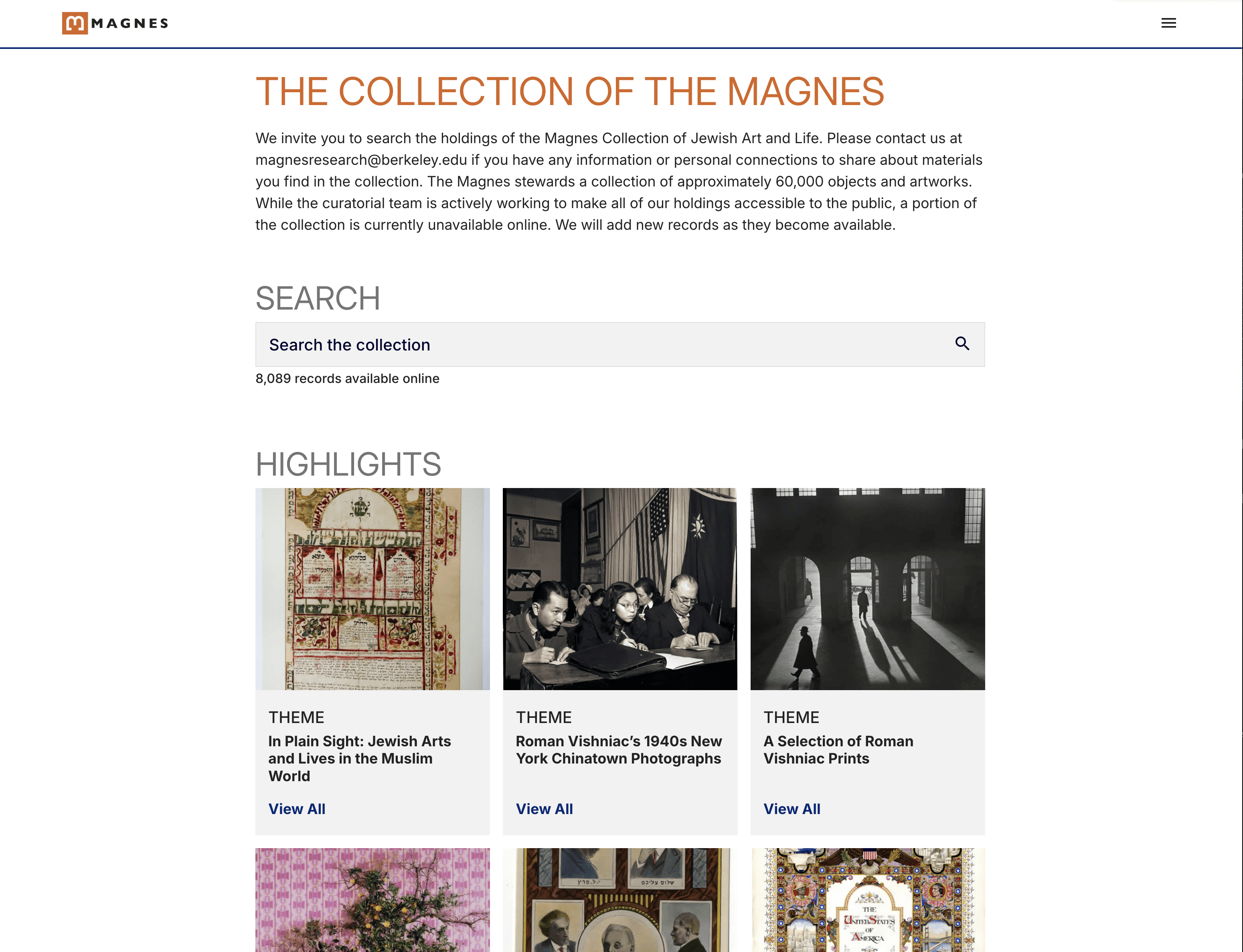
The Magnes Maven, a searchable online portal of records built with Terentia's Collections Engagement tool.
Discover what the Magnes and Terentia’s teams were able to accomplish together:
Access and discovery
Thousands of records and digital assets, finally accessible: Of the Magnes’s 60,000 objects, 16,000 are catalogued in Terentia, with 8,089 records published (at the time of this case study and growing) and fully searchable on the museum’s public-facing portal, Maven.
A new research portal that keeps people exploring: The new Collections Online is ADA-compliant and built to be intuitive. It turns a collection that was once difficult to access into a resource researchers, academics, students, and the public can search anytime, rather than needing to visit the museum in person to explore.
Relevant search results in seconds: With the previous CMS, a single search could take up to 20 minutes, and often yielded unsatisfactory results. Now, that same search takes just seconds in Terentia.
Intuitive search is now a reality: To be successful, a search used to require exact details, like the object’s accession number or its exact title. The new platform has been “a dramatic change,” especially in the handling of broad-scope research requests. “Terentia has made it a lot easier to search across our entire collection,” Andrea says, “We went from having to search in a very limited capacity to a really expansive way of searching.”
New course support for the university’s educators: Staff can now build curated “Themes,” or sets of objects tied to a specific class or subject, giving UC Berkeley faculty a resource their students can revisit before and after a visit. “It helps us establish sets of materials so we don't have to reinvent the wheel every time a new faculty member comes to us,” Hannah explains.
Digital asset management
Unlocking a revenue stream with seamless rights and reproduction workflows: Reproduction requests once meant uploading files to WeTransfer and generating a new link for every requester. Now, the team shares assets directly from Terentia with a temporary, expiring password instead.
Streamlining requests from donors, designers, and the press: Lightboxes let Tina assemble a curated set of high-resolution images for a specific request—such as a donor report, a press release, or an exhibition brochure—and share it with outside partners without duplicating a single file.
Reducing a long-standing photo backlog with bulk upload: As part of the Magnes's ongoing collection inventory, Andrea now uploads reference images and metadata into Terentia every day. “A lot of our objects didn't have any images before,” they say, “and now it's really easy to just upload so many images at a time.”
Collections management
Targeting a cataloguing backlog with custom workflow flags: Tina built a new "staff workflow" section directly into their object records, with custom flags marking items that need registrarial attention, further investigation, or curatorial review. “It’s really going to help us tackle all of these different objects that we haven't looked at in quite some time,” Andrea says.
Taking a culturally sensitive approach with object-specific templates: Tina has built out dedicated object templates for different collection types—art and artifacts, photography, and culturally specific categories like ketubot (Jewish marriage contracts), each with its own descriptive fields.
Tracking location and object condition with new workflows: Andrea is reimagining how the museum tracks objects in storage, along with its approach to condition reporting. With Tina’s help, Andrea built a new condition report procedure for exhibitions in Terentia, adapted from a digital file they’d created. They're also hoping to create a general template that could extend to other procedures, such as accessions, deaccessions, and loans.
Moving research requests from paper to digital: What researchers were interested in used to remain with whoever handled that individual request. The team is now working to log all requests in Terentia, giving the full staff visibility into researcher interests, so that recurring topics can inform future programming and educational materials.
Team and culture
Delivering secure, personalized platform access to every staff member: The previous CMS priced access by user, which limited access to a small number of staff. Terentia’s pricing model lets the Magnes add as many users as it needs. Every staff member and volunteer can now browse the collection, search records, and download approved assets, all governed by granular security settings.
Collaborating seamlessly across departments: The Magnes’s collections and digital departments previously worked in isolation from each other. But Andrea and Tina now collaborate daily within the platform. For instance, Andrea uploads inventory images directly without routing them through Tina first, and Tina can ask Andrea object-level questions and get answers in real time.
Finding more time for meaningful collections work: Staff now describe having more time for the collections work that drew them to the field in the first place, which several noted as a meaningful improvement in day-to-day job satisfaction.
Future
The Magnes makes digital transformation an ongoing commitment
With Terentia in place, the team continues to amp up their digital initiatives, leading with plans for a stronger, more accessible online collection.
Here’s what its staff of eight has in the works:
Expanding access to the Roman Vishniac Archive: In addition to 8,089 records published (at the time of this case study and growing) with images that are published and fully searchable in Maven, making the Roman Vishniac Archive available online remains the Magnes's priority. Tina ingested 20,000 digital assets in August 2026, of which at least 6,000 will have associated records published online by the end of 2026, supported with batch import assistance from Terentia’s team.
Collaborating on a multi-team project, thanks to a long-lost spreadsheet: While auditing files before migration, staff found a spreadsheet of metadata they’d assumed for two years didn’t exist. The find is now feeding directly into the musem’s cataloguing work, and also prompted the collections and DAM teams to take on a broader initiative: reviewing and standardizing the vocabularies used across their entire collection.
Accelerating a multi-year inventory of the permanent collections: Much of the Magnes’s collections has never been catalogued or photographed. Andrea is leading a project to change that. Equipped with Terentia’s bulk upload and metadata tools, they’re able to document as they go, a shift that has greatly sped up the process. “I think it’s going to help provide access to a lot more objects,” they say.
Planning a full website revamp: Using Terentia’s API integrations with web builders, staff intends that every asset on the Magnes’s next site will feed directly from its DAM. The team also plans to include Terentia in the vendor evaluation process, to ensure the new site integrates smoothly from the onset.
“Terentia has opened my eyes. We’re able to imagine new possibilities now. We all wear multiple hats on our team, and I think it’s going to make all of those dreams and ideas possible.”
Andrea Calderon
Registrar & Collections Manager
Key takeaways
Migrating to a unified platform for DAM and collections management allowed the Magnes to absorb the 30,000-object Roman Vishniac Archive, doubling the museum's collections.
Launched Maven, a new online collection, with the goal of publishing 13,000+ records by the end of 2026 as the team processes the newly acquired archive.
Search times dropped from up to 20 minutes to just a few seconds, allowing staff, researchers, and the public explore the collection at their leisure.
Fulfilling your mandate is about to get easier
What once required a towering tech stack and a team of specialists is now possible with just one platform. Find out how Terentia can work for your mission-driven organization.