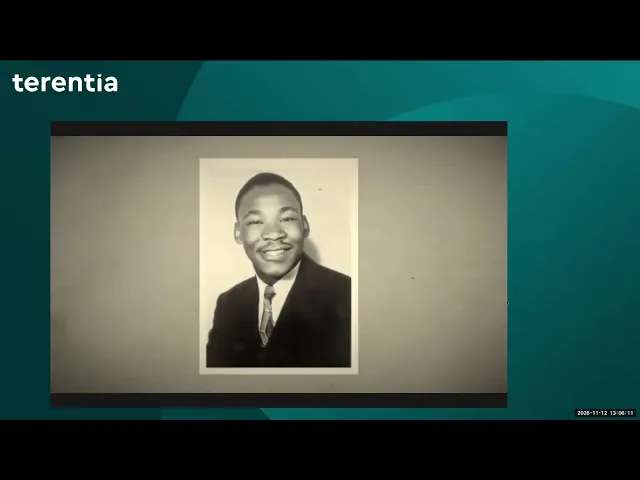
Bringing the Archive Into the Story: The King Center’s “When Faith Calls” and Terentia’s Storyline
See how The King Center connects its documentary series with the archival sources behind it, and what that could make possible for your collections.
Recorded November 12, 2026
Someone watching a documentary hears a name they don’t recognize, or sees a photograph they want to look at more closely. Most of the time, they reach for their phone and start searching. The archive that holds the answer is rarely where they end up.
That moment of curiosity was at the center of our recent conversation with Dr. Kelisha B. Graves, Chief Research, Education, and Programs Officer at The Martin Luther King, Jr. Center for Nonviolent Social Change (The King Center), and Neal Bilow, Founder & CEO of Terentia. Together, they shared how The King Center connected its new six-part documentary series, When Faith Calls, to the photographs, documents, recordings, and records in its archive, and marked the public debut of Storyline.
Their approach points to a broader lesson for museums, archives, libraries, and cultural organizations: the story draws people in, and the collection is what takes them deeper.
Featured speakers
Dr. Kelisha B. Graves
Chief Research, Education & Programs Officer
The King Center
Neal Bilow
Founder & CEO
Terentia
Watch by topic
03:15 — What registrants told us about their video collections
04:51 — Dr. Kelisha B. Graves introduces When Faith Calls
10:19 — Seeing Dr. King as a pastor first
14:19 — The King Center’s archive, and why evidence needs a story
18:05 — Telling the story through 29 interviews across five states
21:28 — Bringing the archive into the viewing experience
25:11 — Inside the When Faith Calls Storyline experience
28:30 — From a 30-second clip to the full sermon
35:24 — Why the archivist stays at the center
40:25 — How time-coded annotations work
47:13 — Q&A: IP ownership and AI-powered search
53:49 — Primary sources as a source of truth in the age of AI
55:39 — Linking to other repositories and digital projects
What we learned from the conversation
Several themes surfaced throughout the conversation:
Evidence needs a story to travel. The King Center holds the world’s largest archive of primary sources on Dr. King and the civil rights movement. As Dr. Graves put it, facts alone rarely reach people the way a story does, so the film became the vehicle that carries the archive to a wider audience.
Curiosity happens in the moment. When a viewer meets a name, place, or object on screen, they want to know more right then. Storyline puts the photograph, document, or person record next to that moment, instead of sending people to a separate search portal or a search engine.
Context, not interruption. Connections sit beside the video as an invitation to go deeper. Viewers who want more can open the full record, or hear the complete 35-minute sermon behind a 30-second clip, without leaving the film.
Professional judgment makes the connections. Archivists, not AI, choose what appears and when. Storyline reuses the records and metadata the institution already has, so provenance and description stay where they belong.
Owning the experience protects the record. The series lives on The King Center’s own site, which keeps the institution in control of its intellectual property. When AI-powered search learns from that content, it points back to The King Center as the source, and Dr. King’s words stay in context.
Primary sources matter more in the age of AI. With so much online content of uncertain origin, a reliable path to the original document offers what Dr. Graves called an authenticity layer: a source of truth that doesn’t change.
See Storyline with your own collections
In a 30–45 minute walkthrough, we’ll show how time-coded annotations could connect your oral histories, archival film or recorded programs to the records you already hold, whether they’re in Terentia or another system.
Evidence needs a story
Dr. Graves opened with a question for the audience: when you hear the name Martin Luther King Jr., who do you see? The chat filled with answers like hero, changemaker, community organizer, and a man marching with others. Only one of the first replies said “a preacher.”
That gap is why When Faith Calls exists. Dr. King saw himself first as a pastor whose public ministry happened to include civil rights. The six-part series follows his faith from childhood in the Jim Crow South through his leadership of the movement. It ends not with his assassination, where most documentaries stop, but with Coretta Scott King, whom The King Center calls the architect of the King legacy.
The series rests on The King Center’s archive, the largest collection of primary source material on Dr. King and the American civil rights movement. Dr. Graves described a challenge every archive shares: the public often thinks of an archive as a library of old papers. In her words, “the evidence needs a story in order to travel into people’s hearts and minds.”
To tell that story, the team recorded 29 interviews across five states, with voices including Rev. Naomi Tutu, Dr. Susannah Heschel, Dr. Bernice King, Rev. William J. Barber II, and Rev. Dr. Otis Moss Jr., who worked alongside Dr. King. Many interviews ran for hours, and Dr. Graves estimated that only 15 to 20 percent of what was filmed made it into the series.
Bringing the archive into the viewing experience
Most productions use an archive for research and a few historical clips, and the connection ends there. The King Center wanted viewers to reach the sources themselves, at the moment they become curious.
In the live demo, a scene about Dr. King’s childhood at Ebenezer Baptist Church surfaces an archival photograph of the congregation. A passage about his mother, Alberta Williams King, opens a short carousel with her biographical record and the Ebenezer senior choir. And a 30-second excerpt of a sermon by Rev. Martin Luther King Sr. links to the full recording, about 35 minutes long, now available to the public for the first time.
The connections appear beside the video, never on top of it. As Neal put it, they are an invitation rather than a pop-up demanding attention. A viewer who wants more can open the record without leaving the film, and one who just wants to watch can keep watching.
How Storyline works
Several attendees asked how the connections work behind the scenes. Here’s how we approached it:
Time-coded annotations. Staff mark a moment in the video and link it to one or more collection records: a photograph, document, person, place, audio recording, or object.
Existing records, not new silos. Annotations draw on the records, digital assets, and metadata already in Terentia. Institutions that use another system can bring that data in.
Every connection is searchable. After the film, viewers can browse and search all of the linked records, just as they would in an online collection.
Outside sources, too. A record can point to another repository or digital project. A simple record in Terentia carries the annotation and links out to the external source.
Room to grow. Each series or film becomes its own digital exhibition, and the same approach works for raw oral histories, gallery screens, and custom designs built on Terentia’s API.
The institution’s data stays its own. Viewer analytics go to the institution’s own Google Analytics. Terentia doesn’t collect them.
Why owning the experience matters in the age of AI
When Faith Calls streams on The King Center’s own site rather than a corporate streaming platform, and Dr. Graves said that was deliberate: the Center wanted to be the author of the experience and keep intellectual control of its collections. One attendee noted in the chat that this also protects provenance, since Dr. King’s words are often taken out of context.
Ownership matters for discovery as well. When AI-powered search learns from the Center’s site, the records it finds are cited to The King Center rather than to a third party. And as Dr. Graves pointed out, a primary source offers a layer of authenticity that generated content can’t match: “you’re not going to change handwriting.”
At Terentia, we’re enthusiastic about responsible uses of AI, but AI does not make the connections in Storyline. Archivists decide what appears and when, because they understand provenance, privacy, ethics, and community context. Our job is to build technology that amplifies that judgment, not replaces it.
Want to keep going on trust and AI? On December 9, Nik Honeysett of Balboa Park Online Collaborative joins Neal Bilow for Beyond the AI Policy: Building Trust Into the Technology, on what happens when responsible-use principles have to become part of the software itself. 1:00 PM ET / 10:00 AM PT. Register for the live session →
What attendees told us
228 people registered and 101 joined live, from as far away as Naknek, Alaska, and Munich, Germany. Before the webinar, oral histories (124 responses) and archival footage (122) topped the list of video content registrants already hold, followed by recorded programs, and documentaries. Of 180 respondents, 81% were exploring what’s possible with no set timeline, and 19% had a project underway or planned in the next 6 to 12 months.
During the session, we asked what attendees would most want audiences to do if their collections could tell their own stories. The top answer, at 40%, was to discover connections between people, places, and events. Exploring the original sources behind a story and experiencing collections more interactively followed at 19% each.
We also asked how easily attendees can connect video with the collection records behind it. Of 55 respondents, only 7% said very easily. 35% said they don’t currently connect them, and another 20% said their content lives in separate systems.
That gap showed up in the chat, too. Several attendees said much of their own film is still undigitized, or listed only on paper, a reminder that connecting video to collections often starts with processing the video itself. All 16 attendees who completed the post-webinar survey rated the session good or excellent.
What this means for your collections
When Faith Calls is The King Center’s story, but the opportunity is a common one. Many institutions already hold oral histories, archival film, recorded programs, and documentaries, along with the records that give them context. As our polls showed, most haven’t yet connected the two.
Storyline was built to close that gap without asking archivists to become something different. The archive remains the foundation, and professional judgment remains central. The technology simply helps audiences reach that knowledge at the moment they want it.
Storyline runs on Terentia’s collections management and digital asset management platform, so the records, assets and metadata you already care for become the connections viewers explore.
The story draws people in. Your collection takes them deeper.
Ready to connect your own video and collections?
See how Storyline works, or book a 30–45 minute walkthrough with our team.
FAQs
More on AI and your collections: How Terentia approaches trusted AI →
Continue exploring
Up next: Beyond the AI Policy: Building Trust Into the Technology
Join Nik Honeysett and Neal Bilow on December 9, 2026, at 1:00 PM ET / 10:00 AM PT.
Terentia Storyline
See how Storyline connects moments in video to the collection records behind them.
Civil Rights Institute of Inland Southern California
How an archive launched its online collection in under a year, with 100% of records migrated.
Preserving the Dream: The King Center & Terentia
Dr. Graves on digitizing the King legacy.
Digital Storytelling for Museums, Collections & Archives
Read more about bringing collections into video experiences.
Explore When Faith Calls
Watch the series and explore The King Center’s digital archive.
Browse our resources


Never miss another webinar
Enjoying our sessions? Sign up for Terentia's mailing list to stay updated on upcoming webinars and events.
