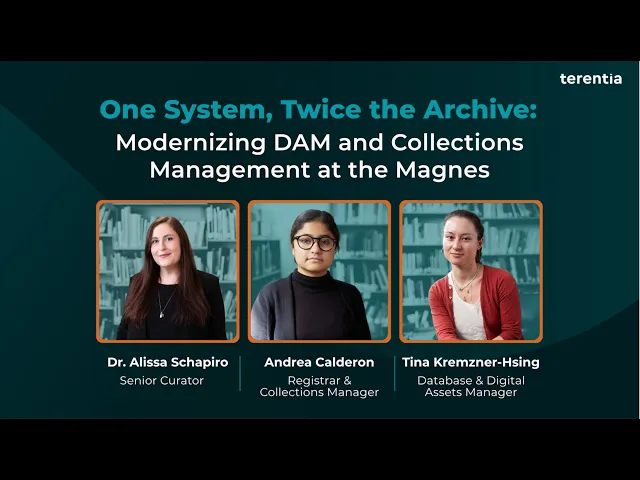
One System, Twice the Archive: Modernizing DAM and Collections Management at the Magnes
What happens when your collection doubles, but your team doesn’t?
The Magnes Collection of Jewish Art and Life at UC Berkeley was already struggling to manage its online collection with its existing system when it acquired the 30,000-object Roman Vishniac Archive. While a major win for their museum, this expansion brought their collection to over 60,000 objects for an eight-member staff to manage.
The team knew it was time to pivot from their disconnected, buggy legacy system. Terentia was the solution they needed to bring collections and digital asset management together in one unified platform.
Watch our webinar of the Magnes story, where Tina Kremzner-Hsing, Database & Digital Assets Manager; Andrea Calderon, Registrar & Collections Manager; and Dr. Alissa Schapiro, Senior Curator, share how they decided Terentia was the right system for them, made the switch, and continue to use Terentia to ensure their collection is accessible to researchers and the public alike.
For a recap of their journey, keep reading to discover how this small team scaled their massive collection with Terentia’s backing.
The Magnes Before Terentia
For approximately 17 years, the Magnes team had used a legacy collections management system and the photo-sharing platform, Flickr, to display images of objects online for public viewing.
This approach left the team toggling between systems with limited museum functionalities. Between connecting to their platform via an unstable VPN to an overseas server and relying on a photo platform with limited search capabilities, the Magnes team experienced constant crashes and couldn’t link collection images to the museum’s records.
As Tina Kremzer-Hsing explained, they had “A record with no image [and] an image with no record.”
When the Magnes made an acquisition that doubled their collection size, they knew it was time to say goodbye to siloed systems and embrace a solution purpose-built for museums.
Scaling up with Terentia
The Roman Vishniac Archive added more than 30,000 photographs, negatives, audiovisual materials, correspondence, and other materials to the Magnes.
Before processing this acquisition, the Magnes had approximately 16,000 records in its collection management system. With the archive, the team expected that figure to reach at least 46,000, with a post-digitalization total of approximately 73,000 digital assets.
As a self-described “department of one,” Tina knew that an integrated collection management and digital asset management (DAM) system was essential to save time and stay within the Magnes budget.
With these needs in mind, the Magnes team turned to Terentia.
“Terentia's Collections online web portal had the features we needed without demanding extra time or money for designing a website from scratch,” said Tina. “We [also] really appreciate Terentia's ethos as a company, not pricing out small institutions from leveraging the best technology, taking client feedback into account with their ongoing improvements to design and functionality, and focusing on working with cultural heritage institutions. We knew that we were in good hands.”
Preparing for the Migration: Collections Data and Digital Assets Clean-Up
Switching to a new CMS can be a time-intensive process, and the Magnes team had its work cut out. Fortunately, they also had the support of Terentia’s implementation and migration team.
Ahead of the move to Terentia, the Magnes had approximately 82,000 collections-related digital assets in its legacy file storage. Of these records, the majority were duplicates or derivatives that didn’t need to move into the new environment. In preparation for the migration, Tina spent months reviewing and cleaning the Magnes’ files, ultimately reducing the digital collection by 75% to just 20,000 assets.
But Tina wasn’t working alone. While she focused on the DAM setup and ingestion, Hailey Majewski, Terentia product specialist, mapped the data from the Magnes’ legacy system into Terentia. With Tina and Hailey working together, the migration wrapped up in three months, setting the Magnes up for a successful public launch in June 2026.
The Terentia Difference: What an Integrated CMS and DAM Changed for Staff
With their new system, the Magnes team finally had the unified collections and DAM system they’d been looking for.
Thanks to Terentia, they now had the ability to:
Search across collection records and digital assets
Configure metadata fields and perform bulk updates
Manage user permissions
Associate assets directly with records without the need for separate servers or applications
Upload images directly and connect them to object records
With this foundation, the Magnes team has streamlined research requests, class visits, rights and reproductions, condition reporting, and other collection workflows to save time and improve researchers’ experience working with the collection.
“Previously, when anyone wanted to know about objects we had in our collection that they might want to come and research, they would have to go through the curators,” said senior curator, Dr. Alissa Schapiro. “Now, with Collections Online, there is such a great ability for people to search for themselves, and have those kind of serendipitous moments of searching and saying, I had no idea that I even wanted to see something like this… This increase in individual versus staff-facilitated research through Collections Online has been transformative, and has given a lot of time back to our small team, to get back to our other various tasks.”
Plus, Terentia’s Collections Engagement solution allowed the Magnes to build public-facing digital experiences. In addition to providing researchers with greater access, visitors could submit feedback on individual object pages, enabling two-way engagement. For example, a visitor might identify someone in a photograph, clarify a location, or provide other additional context that the museum may not already have.
Terentia turned the Magnes’ collection into more than a static archive by creating a system that made stewardship, access, and discovery more accessible than ever before.
How Your Collections and Digital Assets Could Work Together
When the Magnes collection suddenly doubled, they knew they needed to officially move away from siloed tools and invest in a platform that supported museums like theirs. Whether your institution is facing a similar situation or needs to scale for other reasons, an integrated CMS, DAM, and online collections platform is likely the answer.
Terentia empowers museum teams to manage collection records, preserve and organize digital assets, and create online catalogs for public access.
Book a demo with Terentia to discuss how an integrated approach could work for your team.
Browse our resources


Never miss another webinar
Enjoying our sessions? Sign up for Terentia's mailing list to stay updated on upcoming webinars and events.
