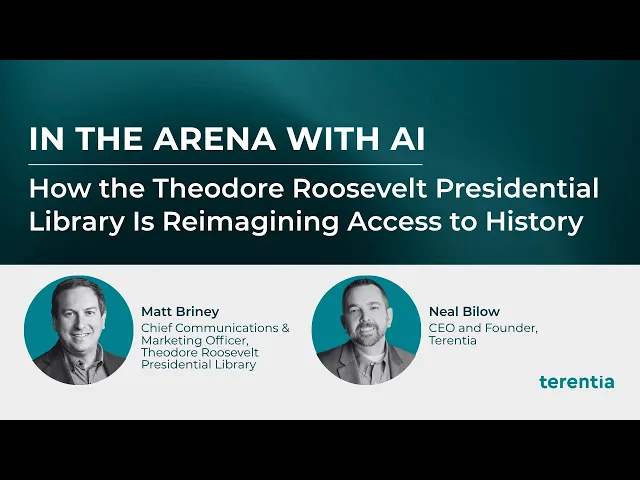
Trusted AI for Museums: Lessons from the Theodore Roosevelt Presidential Library
The Theodore Roosevelt Presidential Library offers a real-world example of how cultural institutions can build AI on trusted collections. Explore the role of citations, human oversight, connected collections, and a Trusted AI Digital Repository in creating responsible AI experiences.
Recorded October 2026 · Updated November 2026
For cultural institutions exploring artificial intelligence, the real opportunity may begin long before the AI experience itself. It begins with a Trusted AI Digital Repository: a foundation that brings collections together, preserves their context and provenance, respects permissions, and allows AI-generated answers to be traced back to trusted source material.
The Theodore Roosevelt Presidential Library (TRPL) offers a compelling example of why that foundation matters. Theodore Roosevelt’s historical record is spread across collections and institutions around the country. Building a new presidential library around that history meant solving a difficult digital challenge: how do you bring distributed collections together, preserve their context and provenance, and make them useful for entirely new forms of research and public engagement?
That challenge was at the center of our recent conversation with Matt Briney, Chief Communications & Marketing Officer at the Theodore Roosevelt Presidential Library, and Neal Bilow, Founder & CEO of Terentia.
The discussion went well beyond the visible applications of artificial intelligence. It explored what has to happen underneath them: connecting collections, establishing permissions, maintaining human oversight, preserving provenance, and giving people a way to trace an AI-generated response back to the historical record.
TRPL’s approach points to a broader lesson for museums and cultural institutions: trusted AI depends on trusted infrastructure. The most important first step may not be choosing an AI experience at all, but building the digital repository that makes responsible, transparent AI possible.
Featured speakers
Matt Briney
Chief Communications & Marketing Officer
Theodore Roosevelt Presidential Library
Neal Bilow
Founder & CEO
Terentia
Watch by topic
03:51 — Where cultural institutions see potential for AI
09:55 — Lessons from large-scale digitization
12:06 — AI for metadata and collections processing
23:43 — Creating a trusted AI environment
26:05 — Campfire: TRPL's AI-powered virtual historian
41:49 — What makes people trust an AI research tool?
48:35 — Building a Trusted AI Digital Repository
55:54 — AI accuracy, RAG, and hallucinations
What we learned from the conversation
Several themes surfaced repeatedly throughout the webinar:
AI needs a trusted source of institutional knowledge. Connecting collections, digital assets, metadata, rights, and context creates a stronger foundation than allowing each new AI project to operate from its own disconnected data.
Provenance and citations matter. An AI research tool becomes more useful when people can move from an answer back to the primary sources behind it.
Human expertise remains essential. AI can accelerate transcription, metadata enrichment, cataloguing, and discovery, but professional review and interpretation remain part of the process.
Governance needs to travel with the content. Rights, restrictions, sensitivities, and access permissions should shape what an AI experience can use and expose.
One trusted foundation can support many experiences. Research tools, internal workflows, educational applications, and visitor-facing experiences can serve different purposes while drawing from the same governed institutional knowledge.
Those ideas are particularly relevant because many cultural organizations are still determining where AI fits into their work.
Where cultural institutions see an opportunity for AI
Before the webinar, we asked registrants where they saw the greatest potential for AI in their collections work. Metadata creation and enrichment was selected by 229 respondents, transcription and OCR by 213, and search and discovery by 193. At the same time, 217 people said they were still trying to understand where AI could help their organization.

The results reflect something we hear frequently from museums, archives, libraries, and other cultural institutions. There is significant curiosity around AI, but most organizations are not looking for technology simply because it is new. They are asking whether it can help address longstanding problems: collections that are difficult to search, inconsistent metadata, backlogs that exceed available staff capacity, disconnected repositories, and digital material that remains difficult for researchers and the public to discover.
TRPL encountered many of those questions while building a new institution around historical material held elsewhere. It started by creating a digital collections foundation capable of supporting the experiences it wanted to build later.
Before trusted AI comes trusted institutional knowledge
It is easy to focus on the most visible parts of museum AI: conversational search, virtual historians, digital humans, automated transcription, or personalized visitor experiences. Those applications are important, but they sit at the end of a much longer chain.
A more fundamental question is what knowledge the AI is being allowed to use, and why that knowledge should be trusted.
At Terentia, we describe the infrastructure behind this approach as a Trusted AI Digital Repository. It is not simply a storage environment or a DAMS with an AI feature added to it. It is a governed institutional knowledge network in which the organization determines which collections, assets, metadata, rights information, and contextual knowledge can be used by downstream AI applications.
That distinction matters for cultural heritage. Museums and archives already have established practices for determining authenticity, recording provenance, managing rights, documenting interpretation, and preserving context. The arrival of generative AI should not require institutions to abandon those practices. A trusted repository extends them into the AI environment.

We think about trust across five interconnected layers. Trusted assets establish which files are authoritative and how versions, derivatives, and preservation copies relate to one another. Trusted metadata provides the people, places, events, creators, provenance, themes, and relationships that give an object context. Trusted rights carry permissions, restrictions, sensitivities, licensing, and reuse rules alongside the content. Trusted workflows introduce review, approvals, auditability, and accountability into AI-assisted processes. Finally, trusted intelligence grounds AI in institutional knowledge rather than asking it to rely on uncontrolled information drawn from across the internet.
TRPL’s implementation provides a useful example of those ideas in practice. Terentia serves as the trusted AI digital repository for the Library’s collections environment, helping create the foundation from which downstream research and public experiences can draw. The institution retains control over the material, metadata, and permissions available to those applications.
Trust means being able to examine the evidence
During the live webinar, we asked attendees a more direct question: What would make you trust an AI-powered collections research tool?
The strongest response was not a more sophisticated model or a higher confidence score. It was the ability to see where the information came from.

Among 178 respondents, 81% selected clear citations back to source records. Sixty-three percent wanted to see the original collection material, 62% valued human review of the underlying data, and 60% wanted the system to clearly indicate when it was uncertain. Verified institutional data and transparency about how an answer was produced also ranked highly.
These responses point to a useful distinction between trusting an AI answer and building an AI experience that makes trust possible. In a museum or research environment, people should not have to accept an AI-generated statement simply because the system presents it confidently. They should be able to inspect its sources, understand where the information originated, and continue their own research.
That philosophy is visible in TRPL’s Campfire experience.
Campfire turns AI into a pathway to the primary source
Campfire allows researchers and the public to ask natural-language questions about Theodore Roosevelt and his era. Rather than requiring someone to know exactly which collection, archival term, or keyword to search, the system provides another entry point into the historical record.
TRPL made an important decision about the role the AI would play. Campfire is positioned as a virtual historian rather than an artificial Theodore Roosevelt. That gives the system the ability to contextualize material from a contemporary perspective rather than forcing every answer through a historical persona.
More importantly, the generated response is not intended to be the end of the research journey.

Campfire can direct users back to underlying collection records, including primary-source material held by the Theodore Roosevelt Center at Dickinson State University. As Matt discussed during the webinar, this changes the role of AI. A researcher does not have to treat the generated answer as an authority. The system can instead help identify material worth investigating and provide a faster route into the original sources.
That may prove to be one of the most useful applications of AI in cultural heritage. The technology does not need to replace the authority of the collection or the expertise of the researcher. It can reduce the friction involved in reaching them.
Human review still matters
The same principle applies behind the scenes.
AI can process large quantities of material faster than a small collections team ever could manually. OCR can make documents searchable. Suggested metadata can accelerate cataloguing. Images and video can be indexed, and relationships that would otherwise remain buried can begin to surface.
But speed does not turn machine-generated information into institutional truth.
During the webinar, Matt described how TRPL distinguishes AI-generated cataloguing information from metadata created by people. That separation preserves an important part of the record: not simply what a field says, but how that information entered the system.
Human review also remains critical. AI can propose a transcription or suggest metadata, but collections professionals still provide the interpretation, judgment, cultural context, and institutional memory needed to determine whether that information belongs in the record.
This is one of the reasons governance cannot be separated from the AI conversation. Responsible AI is not only about which model an institution selects. It is also about creating repeatable processes for deciding what AI can do, where review is required, how changes are documented, and what users need to know about the content they are seeing.
AI may change how people discover collections
For many institutions, the most transformative AI application may not be a digital human or an elaborate visitor experience. It may simply be better discovery.
Digitization alone does not guarantee access. A collection can be online and still remain effectively hidden because its assets and object records are separated, because its metadata only makes sense to an expert user, or because the search interface assumes someone already knows what they are looking for.
Natural-language and semantic discovery can change that relationship. Instead of forcing a user to begin with the correct terminology, a system can allow them to begin with a question, an idea, a person, an event, or a relationship they want to understand.
That is particularly relevant to a collection environment like TRPL’s, where relevant material originates across many repositories. Connecting those records creates the possibility of discovering relationships across collections rather than searching each institutional silo separately.
For researchers, educators, students, and curious members of the public, the impact is not merely faster search. It is the possibility of finding material they might never have known existed.
One trusted repository can support many AI experiences
TRPL also demonstrates why institutions should think beyond one-off AI projects.
Campfire is designed for research and discovery. The Library’s in-gallery conversational Theodore Roosevelt experience has a different purpose, giving visitors an engaging way to encounter the president and his history. Internal collections workflows have different requirements again.
These experiences should not behave identically. Their audiences are different, their objectives are different, and the level of risk associated with an incorrect or inappropriate response may be different.
What they can share is a common foundation of institutional knowledge.

In a Trusted AI Digital Repository model, the institution first determines which sources belong in the knowledge environment. From there, different AI contexts can be created with their own approved data, instructions, permissions, and purposes. Those contexts can then support multiple applications without requiring the institution to rebuild its collections foundation every time a new AI experience is proposed.
That changes the strategic question. Instead of beginning with “Which AI tool should we buy?”, an institution can begin with the knowledge it already stewards: Which sources do we trust? Which collections can be used for which purposes? How do rights and restrictions travel with the content? Where must human review occur? How should a user verify what the AI tells them?
AI models will continue to change. The institutional knowledge underneath them needs to endure.
Building AI on a foundation you control
The opportunity for cultural institutions is larger than adding AI features to existing systems. Museums, archives, and libraries can begin building governed knowledge environments that make their collections useful to many different kinds of AI while maintaining institutional control over the content, context, permissions, and expertise behind those experiences.
That is what makes the TRPL story particularly interesting. The visible experiences—Campfire, conversational interfaces, AI-assisted workflows—are the result of decisions made much earlier about collections infrastructure, metadata, access, and trust.
A Trusted AI Digital Repository creates that foundation. It allows institutions to connect collections records and digital assets, preserve the context and rights attached to them, introduce AI-assisted workflows with human oversight, and selectively make trusted institutional knowledge available to new experiences.
For institutions asking where to begin with AI, the answer may be simpler than it appears: start with the knowledge you already have, make it connected and governable, and then decide what you want AI to do with it.
Explore Trusted AI Digital Repositories
Frequently asked questions
What is a Trusted AI Digital Repository?
A Trusted AI Digital Repository is a governed institutional knowledge network built from collections records, digital assets, metadata, rights information, and other sources an organization has chosen to trust. The institution maintains control over which content is available to AI and how that information can be used.
How is a Trusted AI Digital Repository different from ChatGPT or another public AI tool?
General-purpose AI systems can draw on broad bodies of information that are not controlled by the institution using them. A Trusted AI Digital Repository creates a defined institutional knowledge environment in which the organization determines the sources, permissions, context, and governance behind its own AI applications.
Why do citations matter in museum AI?
Citations give users a path from an AI-generated response to the evidence behind it. In research and cultural heritage environments, this supports provenance, transparency, and independent examination of the primary source rather than requiring users to accept generated text at face value.
Does using AI reduce the need for cataloguers, archivists, or curators?
AI can reduce some of the repetitive work involved in transcription, metadata enrichment, indexing, and discovery, but it does not replace professional judgment. Human expertise remains essential for interpretation, cultural context, rights decisions, quality review, and institutional accountability.
Where should a museum begin with AI?
Begin with the problem the institution is trying to solve. For some organizations, that may be OCR or transcription. For others, it may be connecting collections, improving metadata, or making material easier to discover. Building strong collections data and governance first creates more options for advanced AI experiences later.
Continue exploring
Becoming an AI-Powered Presidential Library
Read the full TRPL case study and explore how the Library moved from distributed collections to a Trusted AI Digital Repository.
Responsible AI for Museums: From Policy to Practice
Explore practical approaches to governance, provenance, transparency, disclosure, and human oversight.
Navigating AI for Museums: A Purposeful Approach to Innovation
Watch the three-part series exploring the foundations, ethics, privacy considerations, and opportunities surrounding AI in cultural heritage.
Browse our resources


Never miss another webinar
Enjoying our sessions? Sign up for Terentia's mailing list to stay updated on upcoming webinars and events.
